
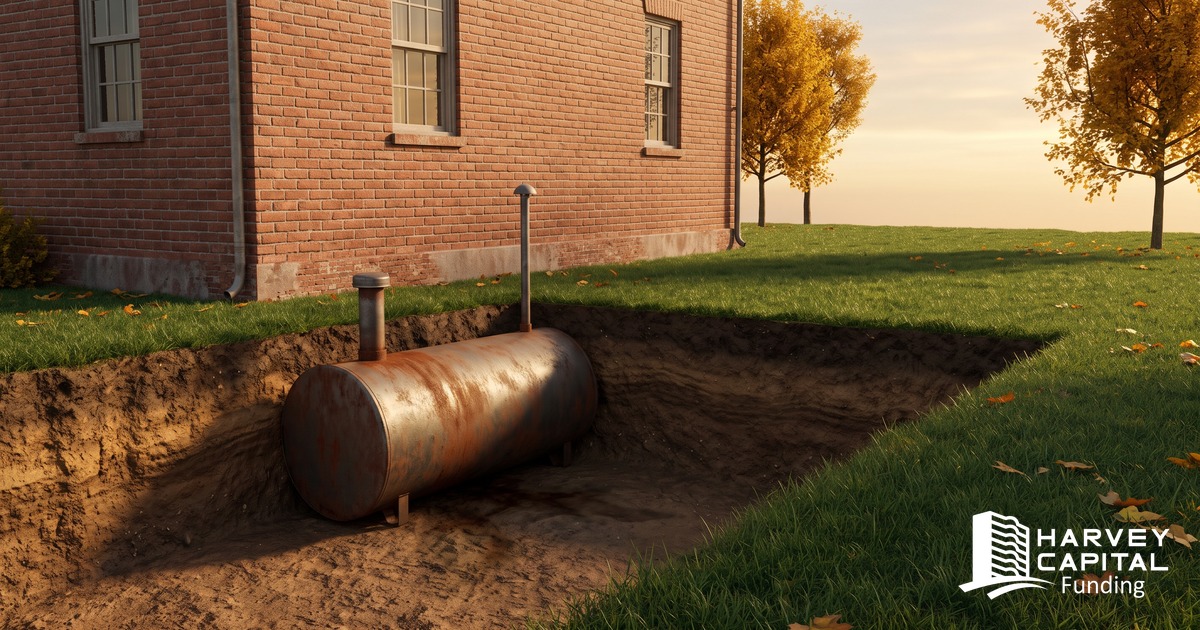
Two pipes stick up from the lawn beside the foundation, one capped and one vented. Those are the surface signs of a buried heating-oil tank. In Virginia, the tank becomes yours at closing, and so does the duty to clean up any oil it has leaked. No agency keeps a list of these tanks, and the state's seller disclosure form does not ask about them. If one leaked before you bought the house, Virginia's Department of Environmental Quality (DEQ) presumes the current owner is responsible for the cleanup.
Why the Tank Is Not in the Paperwork
Federal and Virginia rules for underground storage tanks, the gas-station kind, both exclude tanks that store heating oil burned on the premises. So a buried home heating-oil tank never had to be registered with DEQ. Today's rules also exempt aboveground tanks of 660 gallons or less, which covers the typical 275-gallon basement tank. DEQ's 2015 report to the General Assembly notes that DEQ has no count of heating-oil tanks, because they are not regulated or registered.
The disclosure form will not flag the tank either. Virginia's Residential Property Disclosure Act (§ 55.1-703) is buyer-beware: the owner "makes no representations or warranties as to the condition of the real property," and buyers are told to do their own due diligence, including a home inspection. The form has no question about oil tanks; the only tank in that chapter of the Code is a septic tank.
Some sales come with no disclosure at all. Foreclosure sales, deeds in lieu of foreclosure, sales by an executor or other fiduciary settling an estate, and tax sales are exempt from the Act (§ 55.1-702). A 2014 bill, House Bill 835, would have added a line to the disclosure saying the owner makes no representations about underground pipelines or storage tanks carrying oil or natural gas. It died in a House committee.
How Common These Tanks Are
The U.S. Energy Information Administration's 2020 housing survey found that about 4% of Virginia homes, roughly 140,000, heat mainly with fuel oil or kerosene. That counts houses burning oil today. A tank left behind when a house switched to another fuel is not counted anywhere. DEQ's 2015 report to the General Assembly cites more than 20,000 home heating-oil tank cleanups.
DEQ's public map of petroleum releases, checked in November 2026, shows Richmond City with more release cases from tanks outside the federal rules, the group home heating-oil tanks fall into, than any other locality in Virginia: 4,717, with Henrico second at 3,832. For 2021 through 2025, the map again puts Richmond City first with 316 and Henrico second with 233. The category also covers other tanks outside the federal rules, such as farm fuel tanks, and the map does not show tank type.
What Happens If the Tank Leaked
If oil from the tank gets into the ground, Virginia law (§ 62.1-44.34:19) says it has to be reported to DEQ immediately. The civil penalty for failing to report a discharge, under § 62.1-44.34:20, is "not less than $1,000 nor more than $50,000 for the initial violation, and $10,000 for each day of violation thereafter." The state's tank fund also pays nothing on a release that was not reported.
DEQ presumes the current owner is responsible for the cleanup, even if the tank leaked before you bought the house. Its technical manual treats a buried home tank as a fixture that transfers with the property, and says it is irrelevant whether the owners ever used the tank or even knew it was there. If the house is a rental, the manual says DEQ will pursue the tank owner, usually the landlord, before the tenant.
The statute does let a person who pays sue whoever caused or contributed to the discharge for part or all of the cost. Whether that reaches a prior owner is a question for a lawyer, and it comes after you have paid.
Why Tanks Leak and What a Cleanup Costs
Steel tanks corrode from both sides. Maryland's environment department explains that oil tanks are constantly "breathing," so condensation forms inside, and the water that collects at the bottom can corrode the tank from the inside out. Soil conditions can corrode it from the outside, and buried oil lines can leak too.
Across estimates from Maryland's environment department, a Virginia oil-dealer guide and a national cost guide, a steel tank often lasts 15 to 30 years, sometimes less, depending on the soil, the location and how it was built. An unused tank keeps corroding: Nevada's environmental agency warns that tanks no longer in use "will continue to corrode and, if they still contain oil, will likely contaminate ground water."
Maryland's environment department puts the typical cleanup cost for spills from home heating-oil tanks at $10,000 to $50,000 and says it is "seldom covered by homeowner's insurance." At the extreme, NBC10 Boston reported in July 2025 on a North Attleborough, Massachusetts, family facing an estimated $400,000 bill after about 190 gallons of heating oil leaked into the soil. Their homeowners policy did not cover it. That is a Massachusetts case and an outlier, not a Virginia figure.
In Virginia, DEQ's 2007 reimbursement guidance says "the majority of cases involving heating oil tanks pose minimal risk to human health and the environment."
What Virginia's Tank Fund Pays and What It Does Not
Under Virginia Code (§ 62.1-44.34:11), the Petroleum Storage Tank Fund can reimburse eligible cleanup costs from a heating-oil tank above a $500 deductible, up to $1 million per release.
It pays after the work, not before. You pay the contractor and then file a claim; DEQ's guidance calls the Fund "a reimbursement program and NOT a repayment program." Under Virginia's regulations and DEQ's reimbursement guidance:
- DEQ's regional office has to approve the cleanup in advance. Emergency steps to stop an immediate hazard come first.
- Cleanup done more than 24 hours before the leak is reported is not eligible.
- The Fund pays at DEQ's maximum rates, and only to clean the site to the level of risk DEQ accepts, not to a buyer's or lender's standard.
- The claim has to be filed within two years of DEQ's site closure letter.
The Fund does not pay for:
- A release caused in whole or in part by your own negligence or your contractor's.
- Costs an insurance policy covers, though insurance payments can count toward the $500.
- A neighbor's claims for property damage or injury. For home heating-oil tanks, the Fund pays cleanup costs only.
- Removing or closing a tank that never leaked.
- New carpet after a basement spill. DEQ guidance allows removing oil-soaked materials and restoring the structure to a "safe and serviceable condition," not refinishing it.
In 2015, DEQ told the General Assembly the Fund was in delayed payment status, with claims waiting an average of 256 days, and acknowledged that its regional offices apply the heating-oil guidance differently. Ask your regional office how it handles these cases and how long payment takes now.
The Fire Code and Local Permits
According to DEQ's website, DEQ does not require a home heating-oil tank to be removed, or soil to be sampled when one is closed. The local building inspector or fire marshal might.
Virginia's Statewide Fire Prevention Code does set rules for unused tanks, and its abandonment rules apply to fuel-oil tanks. An underground tank unused for 90 days has to be emptied, with its piping capped or plugged and its vents left open. After one year out of service, it has to be removed or abandoned in place, meaning closed where it sits. The code allows either.
The code lets the local fire official require a permit to remove or abandon a tank, so the rules vary by locality:
- Fairfax County requires a Fire Prevention Code permit and an inspection to remove or abandon a residential fuel-oil tank, except an aboveground tank of 60 gallons or less.
- Arlington County requires a Fire Marshal tank permit for removal or abandonment, and a mechanical permit may also apply if the tank's piping is disconnected or altered.
- The City of Richmond Fire Marshal's permit application lists tank removal permits at $35 to $135. The posted form is several years old, so confirm the fee.
Call your own locality's fire marshal before you schedule the work, and ask which permits, inspections and soil samples they require.
What Comes Up When You Sell
If your buyer uses an FHA-insured loan, FHA's handbook tells the appraiser to note surface evidence of a buried tank, "such as fill pipes, pumps, ventilation caps," and lists "underground storage tanks used for heating oil" among the conditions that indicate soil contamination. Readily observable evidence of leakage means the appraiser must require further inspection, and the lender must confirm the house is free of all known environmental and safety hazards.
The handbook does not say a house with an oil tank is ineligible. FHA's 300-foot rule is about aboveground tanks of more than 1,000 gallons near the property, not the house's own tank. Fannie Mae, a buyer of conventional loans, handles environmental hazards through the appraisal, and its list of hazards does not name oil tanks.
Buyers, lenders and insurers can still ask for more. A Virginia oil-dealer guide says lenders and insurance companies frequently ask a buyer or seller to have an underground tank tested. According to DEQ's website, the buyer, lender or insurer may require removal even where DEQ would approve reimbursement only for removing the oil from the tank. DEQ's technical manual also says its liability exemption for lenders is limited to loans on property with regulated tanks and does not apply to property with any other type of tank.
Homeowners Insurance and Oil Tanks
New York's insurance regulator has explained that the standard homeowners form, ISO's HO-3, excludes pollution claims on the insured's own home unless a named peril (a cause the policy lists) causes the release. New Jersey's insurance department says most homeowners policies exclude pollution liability caused by oil tanks, and that many insurers have underwriting guidelines that may prohibit writing a home with an oil tank. Those are other states' regulators describing standard policies, so read the pollution exclusion in yours.
According to DEQ's website, some home insurance policies cover some of the costs of a heating-oil tank release. For a tank that stays in use, the Virginia Petroleum and Convenience Marketers Association, the fuel dealers' trade group, says a local oil dealer may include the Fund's $500 deductible in a service or tank maintenance contract.
How to Spot a Tank
Outside, look along the foundation and in the yard for a fill pipe (where oil is pumped in) and a vent pipe. According to DEQ's website, signs of a leak include stained soil, strong petroleum odors and puddles of oil. A DEQ checklist reproduced in a Virginia oil-dealer guide adds unexplained dead or withered vegetation, and a rise in fuel use, which can point to a leak in the tank or the lines.
Inside, InspectAPedia, a home-inspection reference, lists the clues an old tank leaves: flexible copper fuel lines coming through the basement or crawl space wall, an old fuel gauge on a basement wall, abandoned oil filters, the footprint of old heating equipment, and patches or cuts in the floor slab where oil lines may have run.
To find a tank nobody mentioned, Nevada's environmental agency suggests asking former owners, neighbors and local companies that might have serviced it, looking for old photographs that show vents or pipes, and using a metal detector.
What to Check Before You Buy
- Walk it. Pipes, stained soil, oil odors and dead grass outside; copper lines, an old gauge or filter and a patched slab inside.
- Ask, and get the paperwork. Ask the seller, the neighbors and any oil company that served the house. If a tank was removed, get the records. DEQ's manual lets an owner rebut its presumption with written evidence that the oil came from a tank a prior owner removed.
- Order a tank sweep (a scan for buried tanks) if anything points to a tank. Pipes in the yard count. Get two quotes and ask how each one scans.
- Test the soil around any tank you find. Bob Vila's 2023 national cost guide puts a soil test for oil at $500 to $1,800. A release the test finds has to be reported to DEQ.
- Price the work. The same national estimates: removing a buried tank, $1,000 to $3,500; an aboveground tank, $300 to $1,000; a basement tank, $500 to $1,500, or $2,500 or more if it is at least halfway buried. Abandoning in place, which includes cleaning and filling the tank and testing the soil, runs $1,000 to $3,000. Add the local permit.
- Put it in the renovation scope and the budget, with the other old-house systems covered in rehabbing a pre-1978 house.
- Do all of this while you can still walk away under the contract.
- At a foreclosure, estate or tax sale, plan for it. There is no disclosure statement at all. Look from the yard for pipes, and budget for a tank if you see them. The liens that survive a trustee sale are covered in what survives a Virginia trustee sale.
The Farmville duplex we funded has a heating-oil tank, and it is written into the renovation scope.
This article is general information, not legal advice. For a specific house, call DEQ's regional office, your local fire marshal and an environmental contractor.
To send us a deal, use the Discuss My Deal form or call 804-208-0465.