
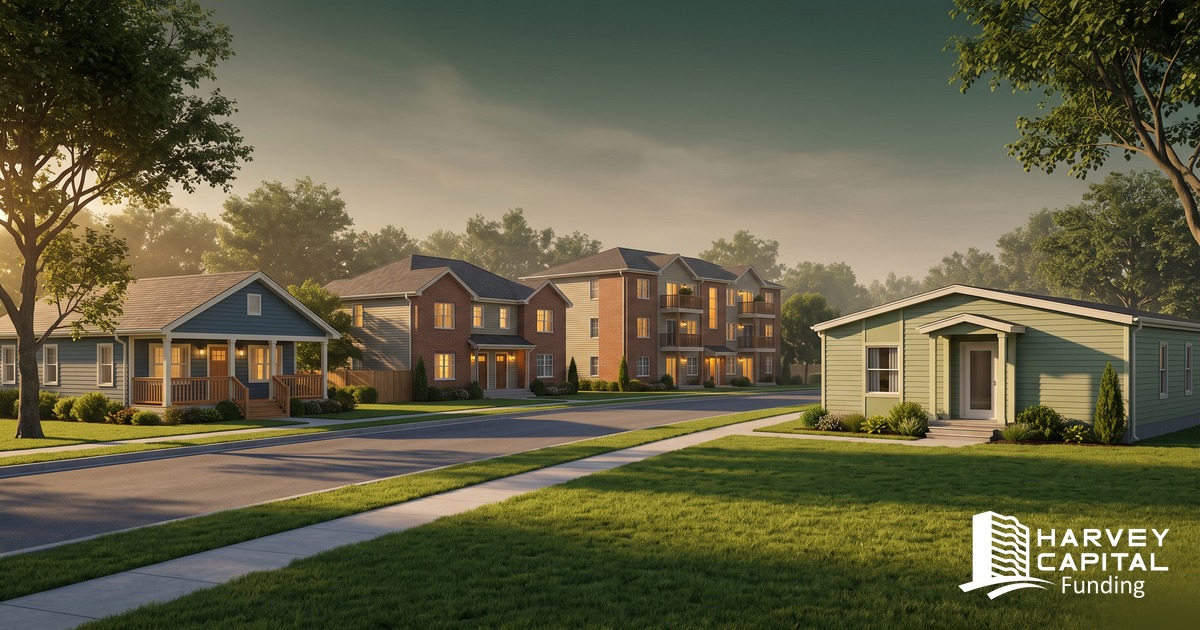
Most lenders start with a dropdown. Property type: single-family, condo, townhome. If your deal isn't on the list, the conversation ends before anyone looks at the numbers. That isn't underwriting. That's a form.
The Dropdown Problem
The dropdown exists for a reason. Lenders who sell their loans have to write what the buyer of the loan will accept, and the buyer wants standard collateral it can model in bulk. A mobile home park, a duplex with a commercial unit, a shovel-ready lot: none of those fit the model, so the intake form filters them out before a human ever sees the file.
That is efficient for the lender. It is expensive for you, because some of the best deals in any market are the ones that don't fit neatly into a category. Less competition on the buy side, more room in the price, and a seller who has already been told no by three banks.
About One in Five
We went back through every loan we have funded. About one in five was not a single-family house.
A mobile home park in Farmville. A manufactured home in Boydton. Two-to-four unit buildings in Danville, Phenix, and Lynchburg. A larger multifamily in Rocky Mount. A townhome in Greenville, North Carolina. A vacant, shovel-ready lot in Wilmington.
None of those fit a box. All of them had the three things we actually underwrite.
The Three Things We Actually Underwrite
Income or an exit. What does the property produce today, or who buys it at the end and at what price? A rental has a rent roll we can read. A flip has a sale price we can defend with comparable sales. Land has a buyer or a build. One of those has to be real, with numbers attached.
A plan. The specific steps between today and that exit. Not "buy and hold" but "buy, bring lot rents to market, sell the trailers to the tenants on rent-to-own, refinance with a local bank once the income has a year of collections behind it." Each step with a number and a timeline.
Value at the end. What the property is worth once the plan is executed, and our loan at or under 70% of it. That cap does not move for an unusual asset. If anything, we lean more conservative when the exit is thinner.
What an Unusual Asset Changes
Property type is not nothing. It is a real risk input, and it can change the shape of the loan in a few specific ways.
It changes how hard we look at the exit. A single-family flip in a neighborhood with twenty recent sales has an exit we can price in an afternoon. A mobile home park's exit is a community bank refinance, so we ask whether that bank exists, what it will want to see, and how long it takes to produce it.
It can change the term. The Farmville park was written for twelve months instead of six because seasoning a rent roll for a bank takes about a year. A six-month term would have manufactured an extension for no reason.
It can change the leverage. A thinner or slower exit means we may write less against the finished value than the cap allows. The 70% is a ceiling, not a target.
And it changes the paperwork. Insurance on a park or a multi-unit building is a different policy than a homeowner's rehab policy. Title work on land with a right-of-way needs another look. None of that is a reason to say no. It is a reason to do the work.
What It Doesn't Change
The discipline. First lien on the collateral. A lender's title policy. Insurance with us named as mortgagee. A value we can defend, and a loan at or under 70% of it. A plan with real numbers and an exit that retires the loan. Those are the same on a $45,000 townhome and a $580,000 multifamily. The asset changes the questions. It does not change the standard the answers have to meet.
How to Bring Us an Odd Deal
Skip the dropdown. Tell us what the property is in plain English, what it produces or who buys it, the steps in between with numbers on each one, and what it is worth when you are done. If there is a current rent roll, send it with the bank statements that back it up. If the exit is a refinance, tell us which bank and what they have said.
When your deal is a good deal in an odd wrapper, you get a real answer instead of an automatic no, usually within a day. See how that played out on the Farmville mobile home park, or call us at 804-208-0465 and walk us through yours.