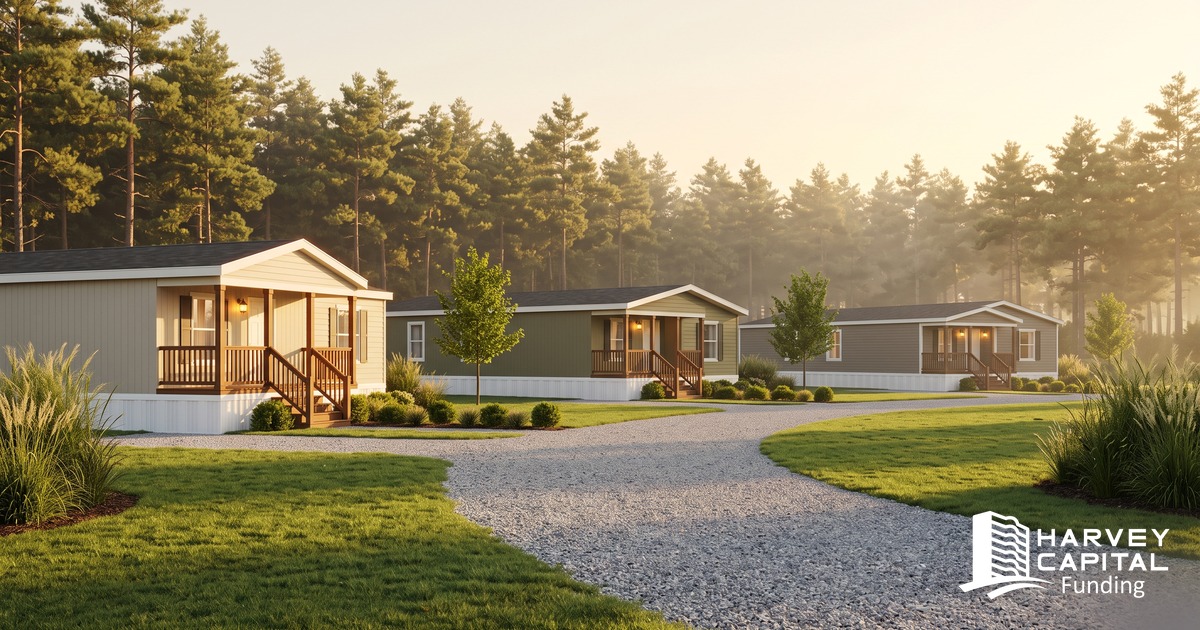
Farmville, Virginia. A mobile home park on three acres, built in 1981, sitting back off a fifty-foot right-of-way with no street frontage to speak of. Not the kind of property that shows up in a lender's dropdown menu.
Why the Models Broke
Automated valuation models are built on houses. They look at bedrooms, square footage, and what similar homes sold for nearby. A trailer park has none of that. There are no comparable sales within any reasonable distance, and the public-record estimate came back at a fraction of the purchase price.
That is the number a bank sees first, and it is the kind of number that ends the conversation before anyone asks what the property actually produces. A park is not worth what a house down the road sold for. It is worth the income the lots generate and what an operator can do with that income.
The Plan Was the Asset
The operator's plan was four steps, and every one of them was specific. Buy the park. Bring the lot rents up to market. Sell the trailers themselves to the tenants on rent-to-own terms, so the residents build toward ownership and the park owner is left collecting lot rent on land instead of maintaining aging homes. Then, once the new rent roll has a year of collections behind it, refinance with a local community bank.
That is a real business plan with a real exit. It is also a plan that requires the money up front, before any of the improvement shows up in the numbers. That gap is exactly where hard money belongs.
The Loan
We funded $215,000 in first position. That covered 100% of the $200,000 purchase price plus $15,000 of improvement money disbursed at closing. The operator brought no down payment.
Stabilized value, once the rents are at market and the plan has been executed, is $340,000. Our loan sits at 63% of that, well inside the 70% cap we hold every loan to. Total lender fees were $7,150. Payments are interest-only, monthly, with the balance due at maturity.
The operator had closed with us before, which is part of why the structure could be this lean. A track record on our own book is the best underwriting document there is.
Why Twelve Months, Not Six
Most of our loans are written on a flip calendar: six months, with extensions available if the project runs long. This one was written for twelve from day one.
Seasoning a rent roll takes time. A community bank refinancing an income property wants to see collections, not projections, and twelve months of deposits is the standard ask. Writing this loan for six months would have manufactured an extension nobody needed and put a fee on the calendar for no reason other than the form said six. The term should match the plan. Here, the plan took a year.
What We Actually Underwrote
Not the automated value. We underwrote the current rent roll and what the lots were actually collecting. We underwrote the plan, step by step, and whether each step had a number attached that held up. We underwrote the exit, which meant asking whether a local bank would refinance this park in a year at a value that retires our loan with room to spare. And we underwrote the operator running it.
Property type went into that analysis as a risk input. It changed the term we wrote and how hard we looked at the exit. It did not end the call. We wrote more about that approach in When Your Deal Doesn't Fit the Box.
What This Means for Your Deal
If you have an income property under contract that a bank cannot value, the problem is usually the model, not the deal. Bring us the rent roll, the plan with numbers on every step, and the exit. We will tell you what we would lend and on what term, usually within a day.
Call us at 804-208-0465 or use the Discuss My Deal form. If the answer is no, you will hear that quickly too.