
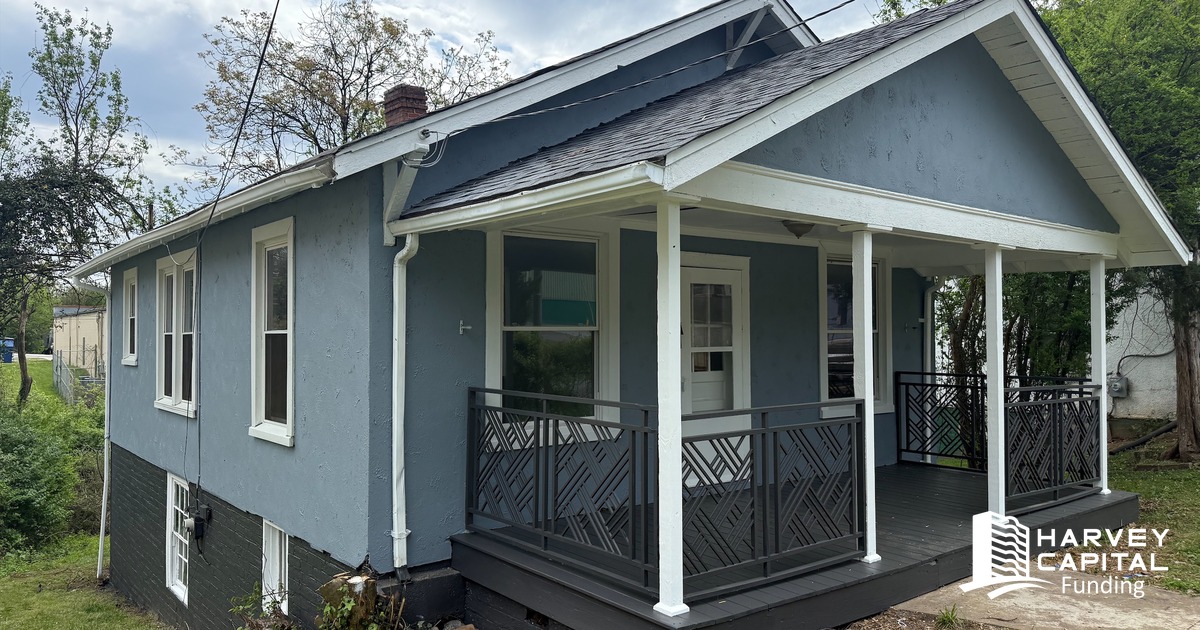
We funded a $55,000 loan on a Lynchburg flip in January. Ten days later, the rehab was finished. Here's what borrowing from us actually looked like — what we did, what we didn't do, and why.
The deal
An experienced operator with over a hundred units in his portfolio brought us a single-family in Lynchburg. He had it under contract for $75,000 with an after-repair value around $90,000. The plan was a classic BRRRR — buy, rehab, refinance into a long-term rental loan, hold the property.
This wasn't his first time, and he hadn't brought us a stretched deal. The numbers were reasonable, the exit was already lined up, and he had been a borrower of ours before. The kind of file we want a lot of.
How we structured it
The structure was a $55,000 first-lien note, six-month term, interest-only. The interest rate was higher than our usual menu, but the borrower paid zero points at origination — just a flat $700 document-preparation fee. That was the trade he wanted. He planned to refinance us out fast, so paying points up front didn't make sense for him. We took the higher rate instead. He saved real money out of pocket at closing, and we still get compensated for whatever time the capital is actually outstanding.
This is the kind of structuring our institutional competitors usually cannot do. They have a warehouse line behind them and a credit committee that dictates the rate sheet. We don't. We control our own capital, which lets us shape the structure around what the borrower actually needs.
No construction holdback
Most hard money lenders fund the acquisition and also withhold a construction reserve, which they release to the borrower in draws as the rehab progresses. It's a normal structure because most flippers want or need it.
This borrower didn't. He owns the contracting company that does his rehabs, which means he wasn't paying retail prices for subs and materials and didn't need our cash to fund the work. He also didn't want the friction of submitting draw requests, sending photos and invoices, waiting for our inspector, and getting reimbursed in pieces.
So we wrote the loan as acquisition-only. Zero construction holdback. He paid for the rehab out of pocket. Between closing and the moment the work was finished, there was nothing he needed from us.
We fund construction draws all the time — for the borrowers who need them. The point is the other direction: when a borrower doesn't need that structure, we don't impose it.
How fast he moved
We funded on January 23. His crew was on-site that day. Ten days later — February 2 — the renovation was finished. Fresh paint, refinished hardwoods, an updated kitchen, repaired trim, exterior touched up. The before-and-after on the front elevation is the photo at the top of this article.
That isn't a typical timeline for a flip. It's the timeline available to a borrower who owns his contracting company and doesn't have to wait on anyone else's schedule. The reason we structured the loan the way we did is the same reason the rehab finished in ten days — the borrower's profile made both possible.
The DSCR refi running long
The plan was to refinance out of our loan within about 30 days of the rehab finishing. As we write this, the borrower is still in the DSCR lender's underwriting queue — about three months in. That isn't unusual. Long-term rental underwriting moves on its own clock, and there isn't much the borrower or we can do about it from the outside.
The reason this isn't stressful — for him or for us — is that the value on the property was already created in the first ten days. The collateral is a finished, rent-ready house, not a half-completed construction site. We're not waiting on weather or contractor schedules or material lead times. We're waiting on paperwork from another lender. That's a much smaller risk surface than most hard money loans carry.
The note matures July 23. Even at the current pace, the DSCR refinance will close well inside our term.
Why we publish these
Most hard money lenders sound interchangeable — fast, flexible, easy. Anyone can say those words. We'd rather show the structure of a specific loan: what the rate sheet actually was, what the holdback structure actually looked like, and how the deal actually moved. The structural answer is more useful than the marketing language.
If you've got a flip, a BRRRR, or any deal you'd like to run by us, the form on Discuss My Deal takes about a minute. We'll respond the same day.