
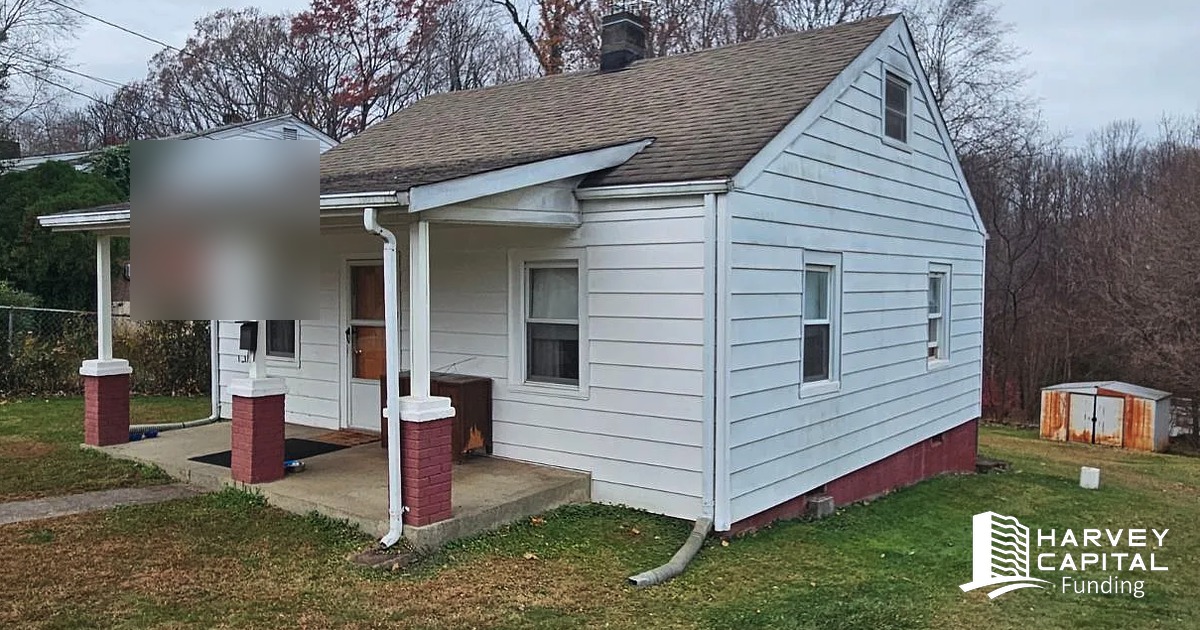
We get asked all the time what an HCF loan actually feels like from the borrower's side. Here's a recent one — start to finish — with the numbers and the decisions we made along the way.
The deal
An experienced operator brought us a single-family in Lynchburg, VA. He had it under contract for $105,000 and saw a path to a $145,000 after-repair value. He needed a hard money loan to close, finish the rehab, and refinance into a long-term rental loan once the property was ready.
On the deal-quality side, this is exactly the kind of file we want to see: experienced borrower, lower price point, conservative ARV, clean title. The kind of loan we want a lot of.
How we structured it
We funded $100,000 on a 3-month, interest-only note at 12%. First-lien position. Two points at origination. A flat $700 fee. That was the whole sheet.
Most lenders would have priced this at three points and stretched the term to six or twelve months by default. We didn't, for one reason: we control our own capital. There is no warehouse line behind us, no institutional partner setting our rate sheet. When a borrower brings a strong file and a short timeline, we can drop a point and shorten the term — which means less cash out of his pocket on day one — without giving up anything on our own annualized yield.
Practically, that meant the borrower wired $2,700 in fees and points at closing instead of $3,700. On a $100K loan, that one point of friction matters.
How fast we closed
From term sheet to wire, this loan moved at the speed an experienced flipper expects from a private lender. He got the term sheet the same day he submitted the deal. He got conditional approval the next day. He had wire instructions in his inbox before contract contingencies expired.
A bank would have spent the same window asking for two years of tax returns and a copy of his driver's license — twice.
The 10-day slip — and how we handled it
The note matured March 22, 2026. The borrower's permanent DSCR refinance closed on April 1 — ten days late. DSCR underwriting routinely slips a week or two on the perm lender's timeline; this one was no different.
Most lenders charge "extension points" when a borrower goes past maturity. On a $100,000 note, an extension would typically run one to two points — meaning $1,000 to $2,000 of fees for a borrower who only needs another week or two.
That isn't fair to the borrower, and it doesn't reflect what extra time actually costs us. So we don't write the loan that way. When the borrower went past maturity, we let the higher per diem rate run for ten days — which cost him $500 instead of $1,000+ — and we still got compensated for the additional time the capital was outstanding.
On April 1, the DSCR refinance closed, the hard money loan was paid off in full, and the borrower had his rental in place at long-term financing.
Why we publish these
Most lenders will tell you they're "fast and flexible." Anyone can say that. We'd rather show what fast and flexible actually looks like on a real deal — what the rate sheet was, what the close timeline was, and how we handled the unglamorous part where the perm lender ran a week behind.
If you've got a flip you'd like to run by us, the form on Discuss My Deal takes about a minute. We'll respond the same day.